Incorporate Solo Melody
Nov. 27, 2025

The guitar is an instrument with a beautiful timbre. When playing a solo without harmony, the string sounds lustrous, and it makes me want to play as if singing.
Adding harmony to a melody makes the song sound more luxurious. Conversely, incorporating a solo without harmony into a song can make the melody stand out and create variation within the song.
Below is the 2nd phrase of Oh! Italia.
Oh! Italia ; 2nd phrase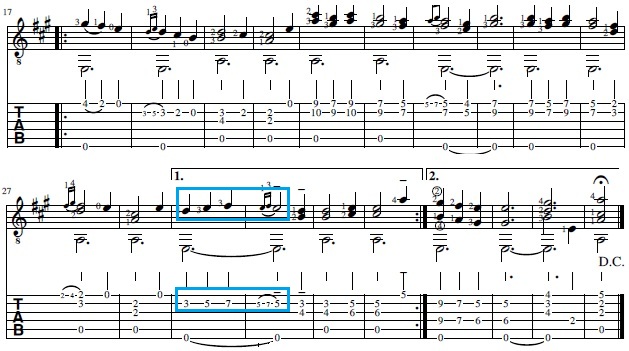
The section marked in blue contains only the bass and melody. Up until this point, 3rd-below harmony has been added, and by suddenly removing it, attention is drawn to the melody. In measure 30, the bass is also skipped for one beat.
On the other hand, in the same position of the second repetition of this phrase (measure 33), 6th-below harmony is added. Since this was my first composition, I experimented with various ideas.
Next example is from the middle part of Mount Adatara.
Mount Adatara ; second half of middle part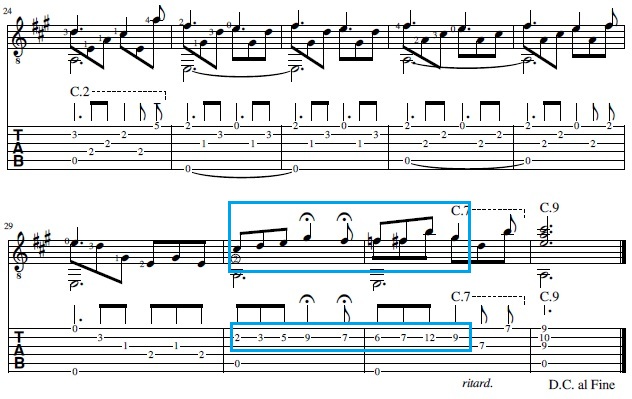
Here, the arpeggios represent the rippling of the lake, the solo the tranquility of the lakeside, and then returning to the beginning, the sound of the four strings expresses the majesty of the mountains.
The solo section is easy to compose because it only has a melody. The only thing I have to decide is whether to play the bass or not. What’s more important is considering the contrast between sections with lots of sound and the solo throughout the entire song. I try to only write solos where it’s important.
In terms of composition, I consider solo section to give the variation throughout the song, but when performing, it becomes the part I most want to sing. Since it only plays a single note, it easy to play. So I can focus on making the string sing.
In both of the examples above, the solo melody is played on the second string. This produces a sweeter sound, and the higher position allows for better vibrato, giving the sound a more lustrous feel. Not only in string selection, but I don’t think pianos can achieve this kind of taste in single-note parts. It’s a charming technique of the guitar.
I’ll give another example. Below is the beginning of ”Evening” which is the 3rd song of Medieval Villages No.3. This example is very different from above two.
Medieval Villages No.3 – Evening 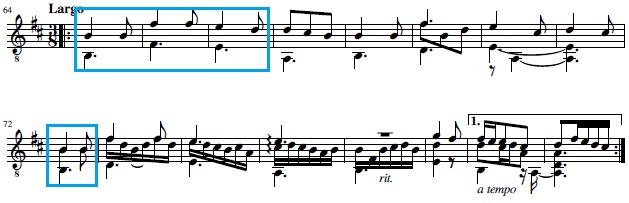
First, there are notes one octave below the melody. These are neither harmony nor bass. They are added to give the solo melody’s tone more body. Without the notes one octave lower, the tone would be thin, as below.
Single tone
Octave lower added
The second difference is the purpose of the solo. In the previous two examples, the sudden disappearance of the harmonies is intended to make the melody stand out. On the other hand, this song begins with a solo to express its theme.
A village at dusk, where sounds have disappeard. And then, as if from nowhere, sounds that shouldn’t be heard begin to seem heard. This solo represents the silent village.
The third difference is that this solo melody is not meant to be sung with emotion. It should be played flat and monotonous. However, it should stand out clearly.
A solo melody is a fascinating guitar music element. It can be used in many creative ways. And it’s an enjoyable element both for composing and for performing.
← Improve The Harmonies / Next Article →
Photo by apfel on PhotoAC