The Making of ‘Plaza de España’
– Feb. 22, 2026
The first topic is about composing with a Spanish theme.
The second topic is about the compositional effort of this piece.
Jun. 14, 2025 : Composed
Feb. 22, 2026 : Published ⇒ Plaza de España
Spain is known as the kingdom of the guitar. Besides, I have never been to Spain. So I felt a great deal of hesitation about writing a guitar piece themed on Spain. But, I wanted to compose it. How should I go about it? That was the dilemma of this composition.
(To be precise, this is my second song about Spain. The first one, which remains unpublished, was composed without hesitation due to certain circumstances. I might write about that another day.)
My impression of Spain was formed by Chabrier’s Rhapsodie España and Rimsky-Korsakov’s Capriccio espagnol, which I heard as a child. Brilliance and splendor. My father loved these pieces, and I too enjoyed listening to them on holidays.
Performances by the Frankfurt Radio Symphony (hr-Sinfonieorchester)
Chabrier- España ∙ hr-Sinfonieorchester ∙ Alain Altinoglu – YouTube ↗
Rimskij-Korsakow- Capriccio espagnol ∙ hr-Sinfonieorchester ∙ Pablo Heras-Casado – YouTube ↗
But the Spanish music I came to know after starting to play the guitar was a complex world where Christian and Islamic music intermingled, and its sound was deeply beautiful, colored by melancholy. Which is the true Spain? Of course, the answer is clear. Chabrier was French, and Rimsky-Korsakov was Russian. I think they depicted their ideal Spain, driven by their romantic longing for the southern land of Spain where the sun shines brightly.
Now, back to my dilemma. It was whether I should write a song about Spain. But, if I were to compose a song not about expressing Spain itself, but about my longing for Spain, then since it would be an expression of my inner self, it should be permissible.
Then what kind of music should I write? Could I write pieces like those of Tárrega or Granados? That would be impossible. I grew up in a different musical environment from them, so I don’t feel those Spanish-style pieces emerging from within me. I realized that what I had inside me was a brilliant and splendid Spain like the pieces of Chabrier and Rimsky-Korsakov. So I decided not to overthink it, but to just compose such a piece I have inside me, and to enjoy playing it. This was the solution to my dilemma.
Alright, let’s start composing! I dug up the following from recordings which I played earlier.
A performance I played earlier
I have many scraps like this, mostly recorded on holiday or after dinner, sitting on the sofa and playing with no particular theme. At the time, I didn’t have a theme in mind, so even I didn’t know what I was playing. However, once the direction of the song is decided, I sometimes find the recording that makes me think, “Ah, maybe I’ll use this.” This time, I felt the opening section of this recording suited “the brilliant and splendid Spain,” so I modified it slightly as follows and decided to use it as the intro.

Intro
To continue composition, I needed a more concrete image of the song. When I need the image, I always look for photos. But what place in Spain?
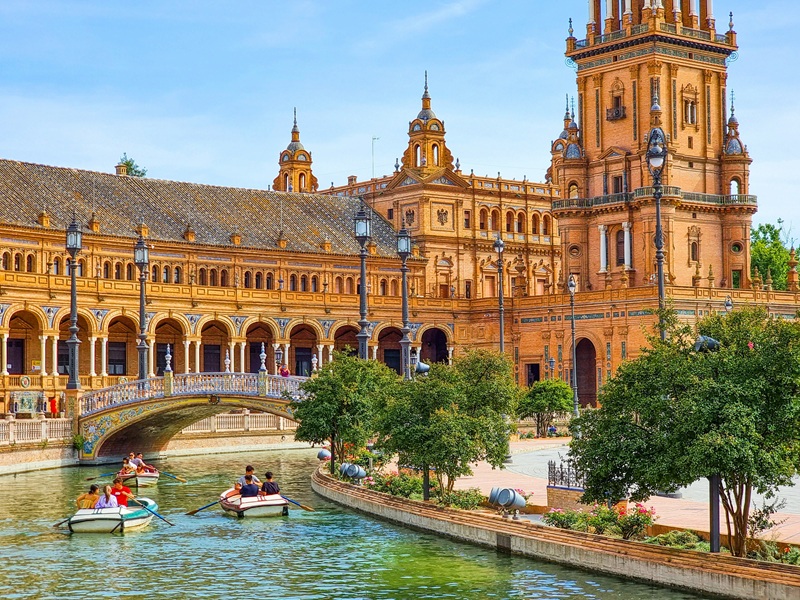
So I listened to Albéniz’s pieces by guitar arrangements: Granada, Córdoba, and Sevilla. Among these, Sevilla was the most brilliant piece. Since Albéniz was Spanish, it’s surely true that Sevilla is a bright and cheerful city. So I searched for “Sevilla” on a photo site, and what came up most frequently was the Plaza de España.
Albéniz’s piano pieces named after Spanish city; Guitar performance by Julian Bream
Julian Bream | Granada | Isaac Albéniz –YouTube ↗
Julian Bream | Córdoba | Isaac Albéniz – YouTube ↗
Julian Bream | Sevilla | Isaac Albéniz – YouTube ↗
Oh, what beautiful pieces, what beautiful performances! Please don’t compare these to mine. 🙂
I thought this Plaza de España, originally built as the site of the Universal Exposition, was designed more to entertain visitors than to evoke a sense of history. So it appears less “splendid” and more like a place “anyone can come and enjoy.” In the end, that became the theme of this composition.
After that, as I was enjoying my nap with the image of the Plaza de España in my mind, a melody followed the intro came to me. It’s a bit commonplace, but I thought I could play it with fun.
A melody that came to me during my nap
But here’s the thing! The intro was in 3/4 time, while this melody was in 4/4 time. It’s a problem. Should I adjust it to 3/4 or change the intro to 4/4? I tried a bit to match the time signatures, but it was hard to change the phrases that had already settled in my mind. So I switched my approach and decided to try combining these two different rhythms into one song. The result is the final score below.
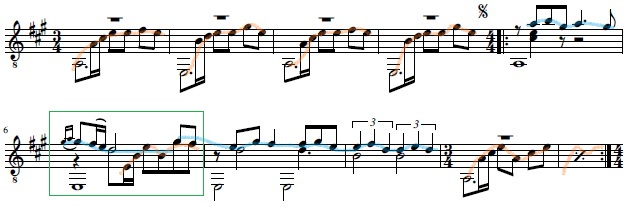
1st phrase
The intro is in 3/4 time, and the melody is in 4/4 time. In the above score, the 3/4 rhythm line is marked in orange, and the 4/4 melody line is marked in blue. In the measure outlined in green square, the same rhythm as the intro is layered over the last three beats of the melody. The measure structure is also unusual: a melody-focused 4/4 section of four measures, followed by a rhythm-focused 3/4 section of two measures. This creates a total of six measures per phrase.
The second and third phrases follow the same structure.
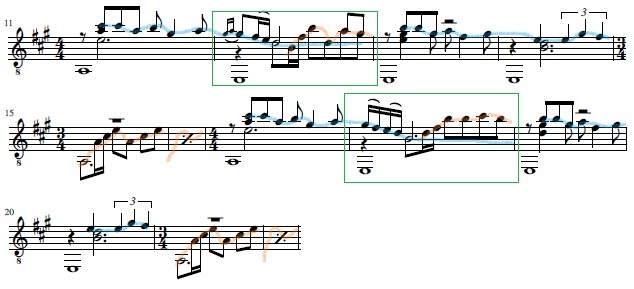
2nd and 3rd phrase
Here, in the green-framed measures, the notes on the 3/4 lines are played in higher pitch to emphasize the presence of the rhythmic element.
This song was composed as above, but isn’t it a “weird” music? Personally, I like it because the rhythm and melody I came up with combined well, and it’s fun to play, so it’s fine with me. But I’ve never seen a score like this. Maybe it’s just weird, and I’m the only one who thinks it’s good.
However, although I have performed this song many times in the living room, nobody has ever said it’s weird. So, maybe this isn’t weird after all? Well then, that’s pretty much the end of the composition.
These kinds of struggles mean nothing to listeners, but as a composer, I can’t help but think around.
The whole score and my performance is below.