Set The Key
Mar. 11, 2026
Up to this point, I’ve written that starting to compose a song requires the mood of the song, and the mood is expressed through tempo, rhythm, and rhythmic sway.
But composition doesn’t start until the first sound is produced. And in order to actually produce the first sound on the guitar, the key must be set.
When comparing tempo, rhythm, and key, anyone can tell whether the tempo is fast or slow. And even I, without any special musical education, rhythm is easy to understand. With a waltz rhythm, my body naturally sways side to side; with a habanera rhythm, I feel relaxed. So, which tempo and rhythm to choose for a particular mood comes naturally.
However, since I don’t have absolute pitch, key is a difficult element for me to comprehend. Symphony titles always include the key name, like “Symphony No. 4 in B flat major,” but even when I listen to it, I can’t tell what key it’s in.
But when it comes to composing my own music, things change. As I have written so far, I try to express my mood into sound using the guitar, but if the key isn’t set, I can’t play the first note.
The following is a fragment of a song I introduced earlier. The reason I can play the first note powerfully even without deciding what kind of song to make is because I’ve decided the key is A major.
An improvisation of “Mood of Joy”
In this example, after playing the first chord, you see that I’m trying to find out the melody I want. But the key is decided.
Then which key should be chosen? Of course, that is up to each composer, but when I select a key, my decision is based on the following four factors.
- Ease of performance
- The suitability of the key for the song
- The use of particular note
- The fact that I just started playing it with that note
Since I mostly compose songs in major keys, I’ll write below about how I choose major keys.
1. Ease of performance :
A, D, or E major is easy. That’s because the root notes of the important chords I, IV, and V can be played with mostly open strings.
- A major : I=A(5th string open)、IV=D(4th open)、V=E(6th open)
- D major: I=D(4th string open)、IV=G(not open)、V=A(5th open)
- E major: I=E(6th string open)、IV=A(5th open)、V=B(not open)
A major is especially easy because I, IV, and V chords can all be played with open strings. And for me, D major is also easy to play because I tend to use the V chord more than the IV chord. However, if you use the IV chord frequently, E major might be easier.
As I wrote in “About Composing,” I only compose in standard tuning, so even in a D major song, the 6th string is E.
2. The suitability of the key for the song :
Below are suitability I feel and songs that best represent it.
A major : for cheerful and warm song. ex) Oh! Italia
D major : for bright and lightweight song. ex) Bougainvillea
E major : for wide range sound and deep resonance song. ex) Serene Summer Night
A major is the key I use most often. To me, it’s the key of a cheerful and warm sound.
D major is a fourth above A major, so the sound becomes brighter. E major is one more higher, making the melody notes more brilliant, and since the I chord’s root note is the open 6th string—the lowest possible note—the bass resonates well at the beginning and end of songs, allowing for compositions with a wider range sound. On the other hand, in D major, I don’t use the 6th string much, so the songs tend to have a lighter sound.
Of course, the impression of a song will vary depending on the composition, but when I’m planning to create a new song, this suitability can be a reference point.
3. The use of particular note :
In Serene Summer Night, I wanted to start the song with notes as far apart in pitch as possible to express a summer night. For that reason, I chose E major and played three octaves apart E notes.
In In The Shade Of Trees, I came up the opening phrase during the work lunch break. When I got home, I tried to find the notes that most closely matched my memory — and it was in E major.
In The Shade Of Trees ; The notes in my brain was for E major
4. The fact that I just started playing it with that note :
In this case, everything explained above is meaningless. When composing Moon Forest, I hadn’t set any key beforehand, but upon seeing the photograph, I immediately began playing the first phrase.
Moon Forest ; Without thinking about the key at all, I just started playing this.
In this song’s score ↗, I wrote two #s, so it’s usually either D major or B minor, but I’m not quite sure what key the opening phrase is in. But anyway, this is the sound I wanted to play, so the name of the key doesn’t matter. I chose the key signature to minimize accidentals, and that ended up being two #s.
Ski Hike and The View From Ruins are also songs I started playing as soon as I saw the photos.
Ski Hike ; This is obviously in A major ⇒Score ↗️
The View from Ruins ; Three #s, but what’s the key? ⇒Score ↗️
I don’t know why I played them in these keys, and I don’t know what is the key of The View from Ruins.
After all, I think it’s best if I can always do the 4th way. Rather than setting a key and then searching for notes, the music that naturally emerges from within me (or from a photograph) makes me most immersed in composing. But it was only after I became accustomed to composing that I was able to produce sounds without setting a key, and even then, it’s only in lucky cases.
In many cases, I start with vague idea about what I want, think about factors 1–3, choose a key that fits the idea, and then play the first sound. For example, if I’m thinking something like, “a song that’s easy to play and feels fun,” I’ll set A major as the key and sound out my guitar. Playing one of the A major chords showed in “Sing With Chord” at a pitch that matches the mood at the time helps me get into the groove.
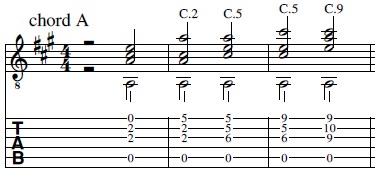
While playing around with various notes in that key, I come across a sound that makes me think, “Ah, this might be good.”
Here’s an example; the composition of “Holiday at the Lake – Lake Garda.”
I was in a good mood that night after enjoying some wine. On the other hand, I was a bit bothered that my earlier piece, Waltz of La Seine, had ended up sentimental despite my original intention to write a cheerful waltz. This time, I really wanted to make a “just cheerful, and easy-to-play waltz.” So I chose A major and the barre chord at the 5th fret – a bit high but has a soothing sound, and I produced the first sound anyway. And then played around while searching for the melody.
The file name was “just-cheerful-waltz-this-time.mp3” 🙂
Oh, I hear my wife clearing the dishes. I’m useless tonight since I’m drunk.
After that, I searched YouTube for scenery that matched this sound and found Lake Garda. I reworked it to match the relaxed and enjoyable holiday atmosphere, and the result is Holiday at the Lake – Lake Garda.
⇒Holiday at the Lake – Lake Garda: Score ↗️
When composing music, sounding the first note is crucial. Hearing the sound actually reach my ears makes my motivation grow stronger.
If the key is set, the first sound comes out easier. And if the rhythm is set, the following sounds flow out easier. Key and rhythm. With these two elements set, the mood can more readily translate into concrete sounds. Mood is just mood, while the song is made of concrete sound. So I need to somehow produce the actual sound.
In the case of Lake Garda, I was able to compose smoothly from the very first note, but often I get stuck and have to stop midway. However, even abandoned sound can later become useful for other compositions, so I record and save them. An example of reusing such recordings can be found in the article “The Making of ‘Plaza de España”
← Sing The Mood / Progress By Bass →
Photo by Marco Ghirello on Unsplash